 The Engineers Club of Dayton initially instituted the Joe Desch Innovention Award in 2008 in recognition of demonstrated excellent in innovative problem solving and the follow-on invention of practical applied solutions. This award is named for the Daytonian who, working in secrecy during World War II, designed innovative and crucial analytical equipment. In that spirit, this award recognizes those who advanced the frontiers of information science, information technology, and allied fields, perhaps with little recognition. Honorees may be in the fields of information science and technology, or may be working in allied sciences and, through their work addressed a significant problem or challenge; advanced the state of the art through technology; or improved the quality of research or product through an innovative approach to education.
Honorees to date
- 2008: John Janning
- 2009: Dr. Peter T. Brody
- 2010: Drs. Ken Jordan and John Birden
- 2011: Whitfield Diffie
- 2013: Dr. Jacek M. Zurada
- 2017: Dan Both
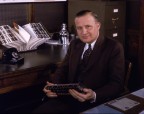
Joseph Desch with early counter
The Engineers Club instituted this award and was then joined by the Dayton Section of the IEEE. In recent years the IEEE has been the prime mover.
The achievements of Joe Desch are significant in this context for he, working in a small lab at National Cash Register Company, developed thermionic tube technology for electronic counters that was part of early digital technology at the outbreak of World War II.
The U.S. Navy, impressed by Desch’s research, then chose his lab to design and build a machine to analyze and read–”break”–communications enciphered on the German Naval Enigma machine during the war.
In 1947 Desch was awarded the Presidential Medal for Merit by Harry S. Truman. This work was not declassified until 1992 and even today is not widely known.
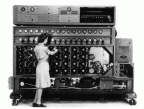
US Navy Cryptanalytic Bombe
When Desch’s cryptanalytic machine was first displayed at the Smithsonian in 1993, it was a showpiece of one of the first exhibits to outline what we now recognize as The Age of Information. The digital technology Desch employed and much of the electronics he studied and advanced are now in the main stream of daily life. This industry has grown to include telecommunications, data standardization and management, computer and server hardware, public cryptography, and many more allied fields.
In October 2001 the U.S. Naval Computing Machine Laboratory was inducted to the IEEE Milestones in Engineering. In 2011 Joseph Desch was inducted into the National Security Agency Hall of Honor. His citation reads : Joseph Desch; Master Engineer, Pioneer of Machine Analysis.
The Joe Desch Innovation Award was instituted by the Engineers Club in 2008 to honor Desch’s legacy. The next year its stewardship was handed to me, Deborah Anderson, Desch’s daughter. Since 2013 I am coordinating with the Dayton Section of the IEEE to bring an added importance to the Award.